SMART ROUTE WHAT IS IT?
Smart route; is the system that evaluates distance, duration, traffic density, road condition, safety, cost and user preferences at the same time while going from one point to another and recommends the most suitable route.
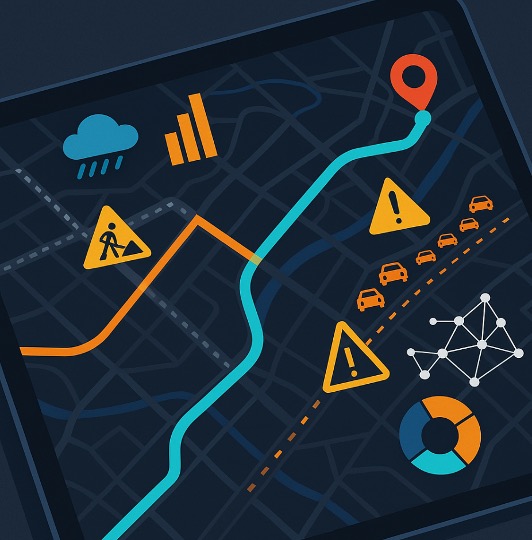
One of the most important features of the smart route is its real-time adaptation capability. For example, when traffic density suddenly increases, when a road is unexpectedly closed or when weather conditions change, the system quickly processes this new information and offers alternative routes to the user.
Smart route is considered one of the fundamental components of modern transportation and logistics management, and it is an advanced planning approach that aims to determine the most suitable route by holistically analyzing various data sources.
Smart route is not merely a navigation tool; it is a comprehensive optimization mechanism integrated with decision support systems, artificial intelligence–based prediction models and Geographic Information Systems (GIS).
In its simplest definition, the smart route is a scientific and technological response to the complex mobility needs created by modern urbanization and digitalization. This concept requires the simultaneous consideration of human behaviors, infrastructure conditions and environmental variables through multi-layered data analytics. Therefore, smart route planning is not only a practical navigation solution; it is also an important component of sustainable urban mobility policies.
WHAT DOES SMART ROUTE DO?
• It shortens the arrival time.
• Analytical calculation models.
• Detects risky roads in heavy rain or lands.
• Factors such as tunnel closures, road works or landslide risks ensure that the driver is directed to safer options.
WHAT ARE THE ADVANTAGES THAT SMART ROUTE SYSTEMS PROVIDE TO BUSINESSES?
1) Increase in operational efficiency
o One of the most critical elements for businesses is to use existing resources in the most efficient way. Smart route systems determine the optimum route for vehicles and personnel used in distribution or field operations and prevent unnecessary distance being traveled.
2) Reduction of costs
o One of the most concrete advantages of smart route solutions is cost savings. .
o Smart route systems provide businesses with valuable data for long-term strategic planning, beyond offering only instant solutions.
3) Reduction of risks and gaining flexibility
o Thanks to real-time data analysis, smart route systems provide businesses with a high level of adaptability in unexpected situations. With situations such as road closures, traffic accidents, weather changes or vehicle malfunctions, the system prevents the operation from being disrupted by offering alternative routes.
WHAT IS PERSONALIZED ROUTE?
In classic route planning, only the shortest or fastest road is calculated; in personalized route planning, the system uses the following types of information:
User’s past driving/travel habits, preferred road types (highway, toll road, quiet street, etc.), real-time traffic, weather conditions, road works, the user’s vehicle type (charging stations for electric vehicles, etc.) — in short, providing the most suitable, most comfortable, fastest or safest route for each user.
In short, personalized route planning is the smart processing system that offers “a special route for everyone” instead of “one route for everyone”.
WHAT ARE THE APPLICATION AREAS OF SMART ROUTE?
Applications that prevent the crowd from concentrating at certain points and offer routes according to visitors’ personal areas of interest provide an important basis for the development of sustainable tourism policies.
ENERGY, INFRASTRUCTURE AND WASTE MANAGEMENT
Electricity, water and natural gas distribution companies and the waste collection units of municipalities are among the main institutions that benefit from smart routing systems. Directing field maintenance teams in the correct order, shortening response times to malfunctions and ensuring waste collection vehicles follow a more regular route both increase service quality and reduce operational costs. Route optimization has become an indispensable tool, especially for public units operating in large geographical areas.
Natural disasters are destructive events that can cause loss of life and property. The destruction caused by earthquakes, floods and fires requires emergency planning and coordination to save human lives and prevent material damage. The safe evacuation of people in the disaster area and the effective routing of emergency vehicles are of vital importance.
4) Increase in operational efficiency
o One of the most critical elements for businesses is to use existing resources in the most efficient way. Smart route systems determine the optimum route for vehicles and personnel used in distribution or field operations and prevent unnecessary distance being traveled.
5) Reduction of costs
o One of the most concrete advantages of smart route solutions is cost savings. .
o Smart route systems provide businesses with valuable data for long-term strategic planning, beyond offering only instant solutions.
6) Reduction of risks and gaining flexibility
o Thanks to real-time data analysis, smart route systems provide businesses with a high level of adaptability in unexpected situations. With situations such as road closures, traffic accidents, weather changes or vehicle malfunctions, the system prevents the operation from being disrupted by offering alternative routes.
WHAT IS PERSONALIZED ROUTE?
In classic route planning, only the shortest or fastest road is calculated; in personalized route planning, the system uses the following types of information:
User’s past driving/travel habits, preferred road types (highway, toll road, quiet street, etc.), real-time traffic, weather conditions, road works, the user’s vehicle type (charging stations for electric vehicles, etc.) — in short, providing the most suitable, most comfortable, fastest or safest route for each user.
In short, personalized route planning is the smart processing system that offers “a special route for everyone” instead of “one route for everyone”.
WHAT ARE THE APPLICATION AREAS OF SMART ROUTE?
Applications that prevent the crowd from concentrating at certain points and offer routes according to visitors’ personal areas of interest provide an important basis for the development of sustainable tourism policies.
ENERGY, INFRASTRUCTURE AND WASTE MANAGEMENT
Electricity, water and natural gas distribution companies and the waste collection units of municipalities are among the main institutions that benefit from smart routing systems. Directing field maintenance teams in the correct order, shortening response times to malfunctions and ensuring waste collection vehicles follow a more regular route both increase service quality and reduce operational costs. Route optimization has become an indispensable tool, especially for public units operating in large geographical areas.
Natural disasters are destructive events that can cause loss of life and property. The destruction caused by earthquakes, floods and fires requires emergency planning and coordination to save human lives and prevent material damage. The safe evacuation of people in the disaster area and the effective routing of emergency vehicles are of vital importance.
Data-Based Decision Making
The basis of smart route systems is the meaningful processing of real-time data. Traffic sensors, satellite data, inner-city camera records, meteorological information and user movements are important components of this process.