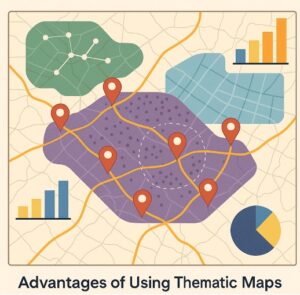

ADVANTAGES OF USING THEMATIC MAPS IN FIELD SALES
Modern businesses find that field sales offer a practical function by enabling direct contact with customers, observing market dynamics on-site, and creating competitive advantages. In fact, increasing the efficiency of field teams and reaching the right customer at the right time—while also optimizing resource usage—requires a strategic approach based on geographical information. At this point, thematic maps stand out as an important tool in the planning, execution, and analysis of field sales operations. Thematic maps are visual analysis tools focusing on a specific theme such as sales potential, competitive density, or logistics networks.
STRATEGIC PLANNING
In thematic maps, visualizing customer segments, income distribution, and consumption habits within a specific region makes it easier for field sales teams to make strategic decisions.
Regions with high potential customers can be quickly analyzed through color intensity or category-based indicators. In short, market opportunities or gaps can be identified more easily. Target regions are determined according to the clustering of potential customer groups, and sales strategies are also shaped accordingly. This essentially means more accurate targeting and higher sales performance.
INCREASING EFFICIENCY
One of the most significant and most visible costs in field sales is time and transportation. Thematic maps visualize customers’ geographical locations and visit priorities, helping create more efficient routes. Visit plans are optimized in real-time. Criteria such as traffic density, regional concentration, and customer visit frequency are included in planning through the map. Sequential visits to customers located in the same area reduce both fuel consumption and operational costs. As a result, field sales representatives reach more customers in a shorter amount of time.
CUSTOMER AND SALES DATA ANALYSIS
In thematic maps, data is not viewed only as numerical tables but also as meaningful geographic representations. In short, it allows for the comparison of sales volumes by region and the visualization of customer behavior as geographic patterns. The reasons behind regional performance differences and areas with high competition can be easily analyzed on the map. Data visualization enables managers to interpret complex information more quickly and make more accurate decisions.
TEAM MANAGEMENT AND PERFORMANCE TRACKING
The performance of field teams can be monitored more transparently thanks to thematic maps. Visits made by representatives, the regions they focus on, and their sales contributions can be marked on the map. Regional efficiency differences become easier to notice. Fairer regional distribution can be made among teams, increasing managerial control and making performance evaluation more measurable.
COMPETITIVE ANALYSIS METHOD
Thematic maps are also used to analyze competitors’ locations and market share distribution. In areas with high competitor density, different strategic approaches can be developed. Special campaigns can be created for regions with low market share. Likewise, the most suitable locations for new product launches can be determined. These analyses help businesses maintain competitive advantage.
IMPROVING CUSTOMER EXPERIENCE
Analyzing customer segments and their locations with thematic maps helps deliver more personalized services. The right message is conveyed to the right customer group. Region-specific campaigns and offers can be developed to increase satisfaction. As a result, customer loyalty and long-term business relationships are strengthened.
COST REDUCTION
Geographic analysis minimizes unnecessary visits, long routes, and operations in low-priority regions. Significant reductions are achieved in fuel, time, and human resource costs. Properly located warehouses, distribution points, and logistics networks make operations more efficient. Cost advantages directly contribute to profit increase.
SAFETY IN RISK MANAGEMENT
Thematic maps allow the analysis of risk factors that may affect field team operations—such as weather conditions, traffic density, and unsafe areas. Risky zones can be marked on the map, increasing team safety. Alternative routes can also be quickly generated. This ensures the continuity of field operations.
CONCLUSION
In conclusion, the use of thematic maps in field sales provides businesses with significant operational and strategic benefits. Visualizing geographic data increases the efficiency of field teams, optimizes resource usage, and strengthens the customer experience. Moreover, they support decision-making processes in many areas—from competitive analysis to cost management. Ultimately, thematic maps stand out as a powerful tool for achieving high performance and more accurate targeting in field sales operations, contributing to sustainable growth.
SCOPE OF THE STUDY
This study examines how the use of thematic maps in field sales management contributes to businesses’ strategic decision-making processes, operational efficiency, and customer relationship management. Thematic maps, one of the GIS-based (Geographic Information Systems) data visualization tools, allow the geographic analysis of customer density, regional market potential, and sales performance distribution.
ANALYTICAL CAPABILITIES OF THEMATIC MAPS
Thematic maps also enable spatial analysis of variables such as customer clusters, competitor locations, and logistical accessibility.
THE IMPORTANCE OF DATA-DRIVEN MANAGEMENT
In recent years, businesses have turned to data-driven decision support systems to manage complex field operations. Among these systems, thematic maps enrich decision processes with spatial data, improving information quality in field management. Thematic maps are visual analysis tools focusing on a specific theme or dataset. Data such as sales volume, customer density, demographic structure, and route density can be visualized using thematic maps. By visualizing data, thematic maps simplify decision-making processes, optimize field operations, and provide businesses with a competitive advantage.